
Termites are among the most destructive household pests in the United States, causing an estimated $5 billion in property damage every year—more than floods, fires, and storms combined in some estimates. Yet many homeowners only notice them once the damage is severe: sagging floors, hollow-sounding walls, or sudden swarms of winged insects.
The key to stopping termites before they create major problems lies in understanding their life cycle. By recognizing the stages—from tiny eggs to massive, mature colonies—you can spot early warning signs and apply effective DIY methods at the precise moments when they work best. This knowledge turns reactive panic into proactive, cost-saving control.
At pestcontrolprice.com, we help USA people compare local pest control prices and services, but the best defense starts with education. In this comprehensive guide, we’ll break down the termite life cycle, highlight species-specific behaviors common across the U.S., explain early detection signs tied to each stage, and detail exactly when and how DIY techniques deliver the strongest results—before you ever need professional intervention. We’ll also cover nuances, edge cases, regional variations, and clear guidance on when DIY is enough versus when to get competitive quotes from licensed experts.
Common Types of Termites in the United States
Not all termites behave the same way, which directly affects control timing and methods. The three main types homeowners encounter are:
- Subterranean termites (most common and destructive): Species like Reticulitermes (native) and Coptotermes formosanus (Formosan, invasive and aggressive). They live in soil, need moisture, and build protective mud tubes to reach wood above ground. Colonies can explode to hundreds of thousands or millions of individuals. Swarming usually occurs in spring after rain.
- Drywood termites: Found primarily in warmer coastal and southern states (Florida, California, Texas, Arizona). They live entirely inside dry wood—no soil contact needed. Colonies grow more slowly (thousands, not millions) but are harder to spot until pellets appear. Swarming peaks in late summer to fall.
- Dampwood termites: Less common but important in high-moisture areas of the Pacific Northwest and coastal regions. They prefer very wet, decaying wood.
Nuance: Subterranean termites cause the majority of structural damage in the U.S. because their hidden colonies expand rapidly once established. Drywood infestations often start in furniture or attic wood and stay localized longer—giving DIY a better window of opportunity.
The Termite Life Cycle: From Egg to Empire
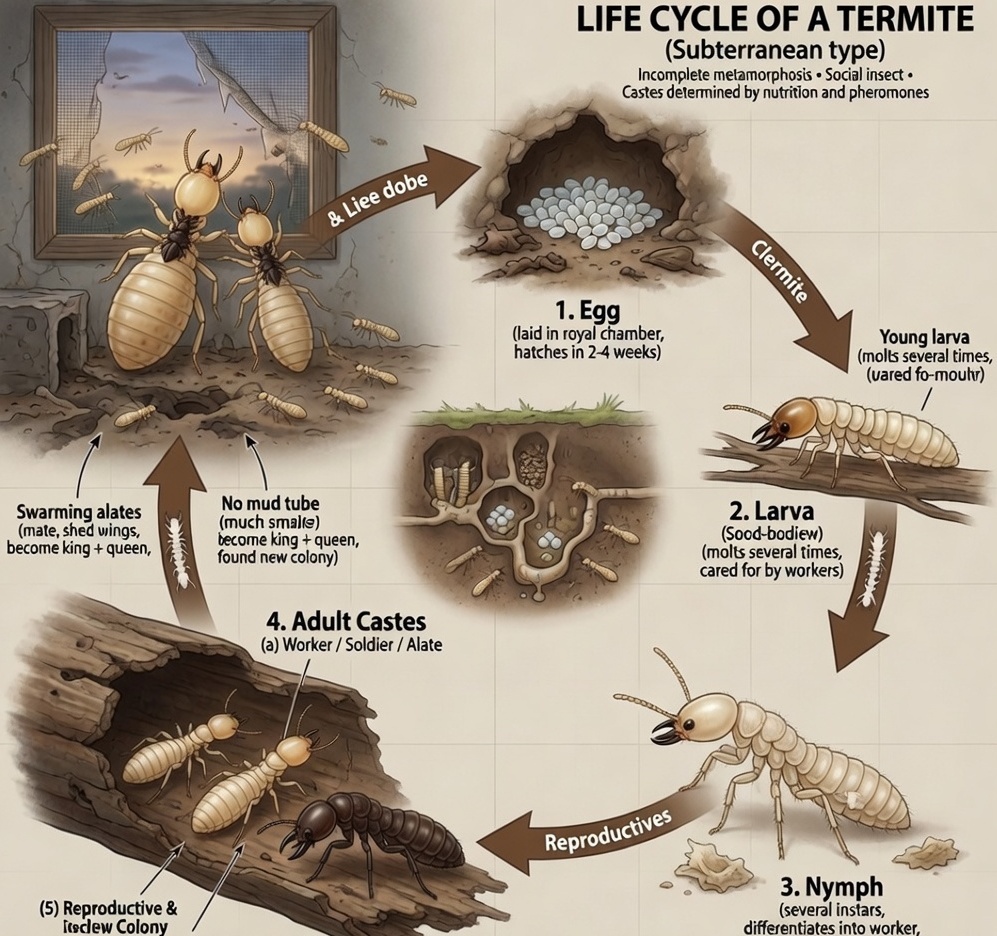
Termites undergo incomplete metamorphosis (three main stages: egg, nymph/larva, and adult), unlike butterflies. Development depends on colony needs, pheromones, and environment. A single colony can last decades thanks to a long-lived queen.
- Egg Stage (The Foundation – Weeks 1–2)
The queen (and sometimes secondary reproductives) lays hundreds to thousands of eggs daily—up to 2,000 per day in mature subterranean colonies. Eggs are tiny, translucent, jelly-bean-shaped, and cared for by workers in the nest. Incubation takes 1–2 weeks depending on temperature and moisture.
Early-control implication: Eggs and the new queen/king pair in a brand-new colony (post-swarm) are the most vulnerable point. If you disrupt a founding pair before they produce workers, the colony never establishes. - Nymph/Larva Stage (The Growth Phase – Months to Years)
Eggs hatch into pale, soft-bodied nymphs (sometimes called larvae). These undergo multiple molts (shedding exoskeletons) over weeks to months. Nymphs cannot feed themselves initially; workers regurgitate pre-digested cellulose. Depending on colony signals, nymphs develop into:- Workers (foragers, caregivers, wood-eaters—the destructive majority).
- Soldiers (larger heads, powerful mandibles for defense).
- Nymphs with wing pads that will become reproductives. This stage is when the colony silently expands. Subterranean colonies can reach maturity (able to swarm) in 3–5 years; drywood may take 2–10 years.
- Adult Caste Stage (The Mature Colony – Ongoing)
- Workers: Blind, wingless, creamy-white; they eat wood 24/7 and tunnel. Lifespan 1–4 years.
- Soldiers: Protect the colony; cannot feed themselves.
- Reproductives: Include the primary king and queen (live 15–30+ years) and winged alates (swarmers). Swarmers develop wings, fly out (often in massive synchronized events), mate, shed wings, and start new colonies. This is the most visible stage. Secondary reproductives can also appear if the primary queen dies, allowing rapid colony recovery.
Key Insight: Colonies start tiny (just the king/queen pair + first brood) and grow exponentially. The first 1–2 years are the “quiet phase” where damage is minimal and DIY can still succeed.
Early Warning Signs Tied to the Life Cycle
- Swarmers or discarded wings (reproductive stage): Piles of wings near windowsills or doors signal a mature colony nearby—act immediately.
- Mud tubes (subterranean workers): Pencil-thick, brown soil tunnels on foundations or walls.
- Frass/pellets (drywood workers): Tiny, seed-like droppings (looks like sand or coffee grounds) under infested wood.
- Hollow wood or bubbling paint: Workers hollowing out timber (advanced nymph/adult stage).
- Blisters or sagging: Early structural weakening.
Edge case: In dry climates or slab foundations, subterranean tubes may be harder to spot. New construction with wood debris buried nearby can accelerate colony establishment.
When DIY Methods Work Best – Timing Is Everything
DIY termite control shines brightest before a colony matures—specifically during the founding pair phase, early nymph growth, or when you catch the very first swarmers. Once workers number in the thousands and mud tubes or extensive tunneling appear, the colony is too established for most DIY approaches to fully eradicate. DIY treatment costs under $100.
Best windows for DIY success:
- Immediately after spotting swarmers (spring for subterranean, late summer/fall for drywood): The parent colony is sending out reproductives, but new satellite colonies may still be small.
- Prevention during construction or renovation (before eggs are laid in new wood).
- Localized drywood infestations in furniture or non-structural wood.
- Early mud-tube discovery on a single foundation area.
Proven DIY methods tied to life cycle stages:
- Prevention (Stops Eggs and New Colonies)
- Eliminate moisture: Fix leaks, improve ventilation, slope soil away from foundation.
- Remove wood-to-soil contact: Keep mulch/stored lumber 6–12 inches from walls.
- Seal cracks and install metal termite shields during repairs. Why it works: New kings/queens need moist, accessible wood to start laying eggs.
- Boric Acid / Borate Treatments (Targets Early Nymphs & Workers) Mix borax with sugar or water into a bait spray/paste. Termites ingest it while foraging and share it via trophallaxis (food-sharing), killing the young colony before it grows. Excellent for drywood or exposed wood.
- Cardboard Traps & Bait Stations (Early Worker Foragers) Wet cardboard near suspected areas attracts workers. Once covered, remove and destroy (or treat with insecticide). Home bait kits with fipronil or imidacloprid can slow small colonies.
- Liquid Soil Treatments (Subterranean Early Tunneling) Available DIY termiticide kits (imidacloprid or fipronil-based) create a chemical barrier. Best around foundations when mud tubes first appear—before the colony goes deep.
- Natural Options (Supportive Early Control) Beneficial nematodes, diatomaceous earth, or essential oils (orange, neem) disrupt early nymph feeding but are supplementary only.
Realistic expectations and nuances: DIY can delay or eliminate very young colonies and prevent new ones. However, it rarely reaches the queen in a mature subterranean colony hidden 10–20 feet underground. Studies and pest experts consistently note that incomplete treatment allows rebound via secondary reproductives.
Regional edge cases:
- Southern states (high subterranean pressure): DIY works best as annual prevention.
- California/Arizona (drywood common): Spot-treat furniture early with borates.
- Pacific Northwest: Focus on dampwood by removing decaying wood.
When DIY Is No Longer Enough – Call the Professionals
If you see extensive mud tubes, widespread frass, structural damage, or repeated swarming, the colony is likely mature. At this point, professional treatments (soil injection, bait systems like Sentricon, or whole-structure fumigation for drywood) offer warranties and guaranteed colony elimination. Getting multiple quotes ensures you pay a fair price – exactly what pestcontrolprice.com is built for.
Prevention Strategies for Long-Term Peace of Mind
- Annual inspections (DIY visual checks + professional every 2 – 3 years).
- Maintain treated wood in new builds.
- Monitor swarm season in your region.
- Combine DIY barriers with professional monitoring stations.
Conclusion: Knowledge Is the Ultimate Termite Defense
Understanding the termite life cycle transforms you from a victim of hidden damage into an informed homeowner who acts early. By intervening at the egg, nymph, or early swarming stages with targeted DIY methods, you can often prevent major structural problems and save thousands in repairs. Prevention and early detection are always cheaper – and more effective – than late-stage remediation.
Ready to protect your home? Visit pestcontrolprice.com today to compare termite treatment prices from trusted local providers in your area. Get free, no-obligation quotes tailored to your specific situation and take control before termites do.
Frequently Asked Questions
What is the life cycle of a termite?
Egg → nymph (multiple molts) → adult castes (workers, soldiers, reproductives). Full colony maturity takes 2–5+ years.
Can DIY methods really control termites early?
Yes—when caught at the founding or early nymph stage through prevention, borates, or spot baits. Mature colonies usually require professional help.
When do termites swarm in the U.S.?
Subterranean: spring (after rain). Drywood: late summer/fall. Timing varies by region and weather.
How long do termite queens live?
15–30+ years, allowing massive colony growth if not stopped early.
Stay ahead of termites. Knowledge + timely action = a protected home. Share this guide with neighbors and bookmark pestcontrolprice.com for ongoing pest control resources and pricing comparisons.