
How Exterminators Break Down the Price Internally
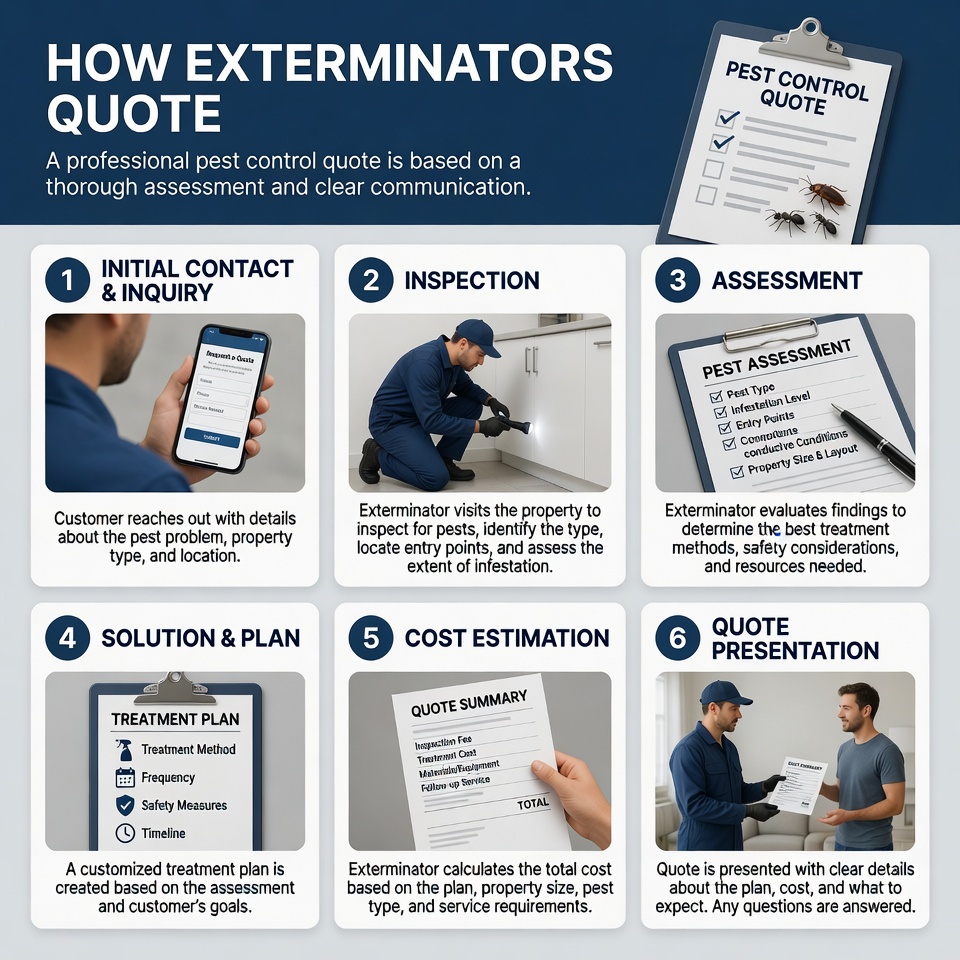
When a homeowner receives a pest control quote, the price can sometimes feel confusing. One company may quote $150 for a basic ant treatment, while another may quote $300 for what sounds like the same problem. For larger jobs like termites, bed bugs, rodents, or wildlife exclusion, the difference can be even bigger.
The reason is simple: exterminator pricing is not based only on the chemical used. A professional pest control quote includes labor, travel, materials, inspection time, risk, licensing, insurance, office support, marketing cost, follow-up visits, and profit.
In other words, when a customer pays $250 for pest control, the exterminator company does not keep $250 as profit. A large part of that money is already assigned to job costs and business costs before the technician even arrives at the home.
This guide explains how exterminators internally break down pest control cost, what percentage of the quote goes toward each cost, and how gross profit and net profit work in a real pest control job.
Formula Behind Pest Control Pricing
Most exterminator quotes can be understood with this simple formula:
Final Customer Price = Direct Job Cost + Business Overhead + Risk Reserve + Net Profit
Each part matters.
Direct job cost is the money spent to complete that specific service. This includes technician labor, chemicals, traps, bait, protective gear, and vehicle use.
A pest control company has many expenses that keep the company operating, including office staff, scheduling software, insurance, licenses, rent, phones, websites, advertising, and training.
These expenses contribute to the overall cost of running the business and must be factored into service pricing to ensure profitability. As a result, the company needs to set service prices at a level that covers these operational costs while still remaining competitive in the market. All normal costs are deducted from the net profit.
This breakdown explains why a professional pest control quote may be higher than a DIY product from a store. The quote includes professional time, safety, experience, equipment, and accountability.
Typical Internal Pest Control Cost Breakdown
Every pest control company has different numbers, but a realistic internal breakdown for many residential jobs may look like this:
| Cost Category | Typical Share of Customer Price | What It Covers |
|---|---|---|
| Technician labor and payroll cost | 25%–35% | Technician time, payroll taxes, benefits, training |
| Chemicals, bait, traps, and supplies | 5%–12% | Pesticides, baits, traps, PPE, application tools |
| Vehicle, fuel, and route time | 5%–10% | Gas, truck maintenance, drive time, equipment wear |
| Office/admin support | 5%–10% | Scheduling, customer service, billing, reminders |
| Insurance, licenses, software, compliance | 5%–8% | State licensing, insurance, CRM, safety records |
| Marketing and sales cost | 8%–15% | Website, ads, phone leads, sales time |
| Warranty or callback reserve | 3%–8% | Free re-service, follow-up visits, customer support |
| Net profit before tax | 10%–20% | Actual business profit after normal expenses |
These percentages are not fixed rules. A small local company may spend less on advertising but more on route time. A large company may have stronger systems but higher office, software, and management costs. A specialized termite or bed bug job may have higher materials, more labor, and higher warranty risk than a basic general pest treatment.
Gross Profit vs Net Profit in Pest Control
Many homeowners hear the word “profit” and assume the company keeps most of the quoted price. That is not how pest control costing works.
There are two important profit numbers:
Gross Profit
Gross profit is the money left after direct job costs are removed.
Gross Profit = Customer Price – Direct Job Cost
Direct job costs usually include technician labor, product, equipment, and vehicle cost for that job.
Let’s say the customer pays $250 and the direct job cost is $115:
$250 – $115 = $135 gross profit
Gross profit is not the final profit. Overhead expenses like marketing, insurance, staff, software, rent, phones, licenses, taxes, and warranty service still have to be paid.
Net Profit
After overhead and direct job costs are subtracted, you get net profit.
Net Profit = Customer Price – Direct Job Cost – Overhead
If the customer pays $250, the direct job cost is $115, and overhead is $95:
$250 – $115 – $95 = $40 net profit
So the company’s real profit is $40, not $250.
Typical Roach Treatment Quote: $275
Imagine that a 1,800 square foot residential property has a moderate cockroach problem. The roaches are mostly in the kitchen, laundry area, and bathroom. The pest control company gave a quote of:
Initial roach treatment: $275
This price includes inspection, treatment, bait placement, crack-and-crevice application, basic prevention advice, and a short service warranty.
Here is how that $275 may be broken down internally:
| Cost Item | Dollar Amount | % of Quote |
| Technician labor and payroll burden | $85 | 31% |
| Gel bait, spray product, traps, PPE | $22 | 8% |
| Vehicle, fuel, and route time | $20 | 7% |
| Total Direct Job Cost | $127 | 46% |
| Gross Profit | $148 | 54% |
| Scheduling and admin support | $22 | 8% |
| Insurance, license, software, compliance | $17 | 6% |
| Marketing and lead cost | $33 | 12% |
| Warranty/callback reserve | $14 | 5% |
| General company overhead | $20 | 7% |
| Net Profit Before Tax | $42 | 15% |
In this example, the customer pays $275. The company’s gross profit is $148, or 54%. But after overhead and warranty risk, the estimated net profit is only $42, or 15%.
Pest control companies have to plan
quote carefully. If they underquote the job, it might look cheaper at first, but they might not have enough margin to do a good job.
Real-Life Example: $450 Rodent Control Quote
Rodent jobs are usually more complicated than general pest control. Mice and rats may need trapping, bait stations, sealing recommendations, attic checks, garage inspections, crawlspace access, and follow-up visits.
Let’s say a homeowner hears scratching in the attic and sees droppings. After inspecting the property, the company quotes:
Rodent control service: $450
Here is a possible internal breakdown:
| Cost Item | Dollar Amount | % of Quote |
| Technician labor and inspection time | $140 | 31% |
| Traps, bait stations, PPE, supplies | $45 | 10% |
| Vehicle, fuel, route time | $35 | 8% |
| Total Direct Job Cost | $220 | 49% |
| Gross Profit | $230 | 51% |
| Admin and customer communication | $35 | 8% |
| Insurance, licensing, software | $27 | 6% |
| Marketing and sales cost | $50 | 11% |
| Follow-up/callback reserve | $40 | 9% |
| General overhead | $25 | 6% |
| Net Profit Before Tax | $53 | 12% |
Rodents have a higher risk than roaches, so the net profit percentage is lower. If you still hear noises after the first visit, the company may need to come back. Also, there might be hidden entry points, attic conditions, sanitation issues, or structural gaps.
So even though the quote is $450, the true profit may only be around $53 before tax.
Why Some Pest Control Jobs Have Higher Profit Margins
Not every pest control job has the same margin. Some services are more profitable because they are faster, more predictable, or recurring.
General quarterly pest control often has better long-term profitability because the technician can treat the exterior, monitor activity, prevent infestations, and keep the home on a planned route. The company already knows the property, so each visit is more efficient.
Sometimes specialty jobs are more expensive, but they aren’t always more profitable. Termite, bed bug, wildlife, and rodent jobs involve more labor, equipment, materials, liability, and customer support.
Treatments for bed bugs can be expensive, but they also involve a lot of prep, several rooms, customer education, reinspection, and retreatment. Drilling, trenching, bait systems, chemical barriers, reports, and long warranties are all part of termite work.
Profit isn’t always linked to price.
Why the First Visit Costs More
First time pest control visits are usually the most expensive because they involve more work.
On the first visit, the exterminator might need to:
- Inspect the property
- Identify the pest correctly
- Find entry points
- Check moisture, food sources, cracks, gaps, nests, or activity zones
- Choose a treatment method
- Apply products safely
- Place bait or traps
- Explain prevention steps
- Set up a follow-up plan
When a technician visits the same property again and again, the visit is usually shorter. Because of this, monthly, bi-monthly, and quarterly plans often cost less per visit.
Why Cheap Quotes Can Be Risky
If a quote sounds too good to be true, look carefully at what is included.
A low quote may exclude:
- Full inspection
- Follow-up visits
- Warranty
- Interior treatment
- Exterior treatment
- Attic or crawlspace inspection
- Entry-point recommendations
- Proper documentation
- Licensed technician support
If the pest problem returns, spreads, or causes damage, cheap pest control can become expensive. For example, a low-cost roach spray may reduce visible activity for a few days, but if baiting, sanitation advice, and hiding areas are not addressed, the infestation may continue.
A good quote should clearly explain what the customer is paying for.
What Homeowners Should Ask Before Accepting a Quote
Before choosing an exterminator, homeowners should ask:
- What pest is included in this quote?
- Is the inspection included?
- Which rooms or areas will be treated?
- Is exterior treatment included?
- What products or treatment methods will be used?
- Is there a follow-up visit?
- Is there a warranty or re-service policy?
- Are there any extra charges?
- Is this a one-time service or recurring plan?
- Is the company licensed and insured?
A professional company should be able to answer these questions clearly. If the quote is vague, the homeowner may not know what they are actually buying.
Sample Quote Breakdown for Homeowners
Here is a simple way to understand a pest control quote:
If the quote is $300, the internal breakdown may look like this:
| Category | Approximate Amount |
| Labor and technician time | $90 |
| Products and supplies | $25 |
| Vehicle and travel | $25 |
| Admin and scheduling | $25 |
| Insurance, software, licensing | $20 |
| Marketing and sales | $35 |
| Warranty/callback reserve | $20 |
| Company overhead | $20 |
| Net profit before tax | $40 |
So from a $300 service, the company may only keep around $40 as real profit before tax. That is about 13%.
This is why pest control companies need proper pricing. They are not only charging for chemicals. They are charging for professional labor, risk, route time, business costs, and reliable service.
Final Takeaway
Exterminator pricing is built from many moving parts. A pest control quote includes the cost of labor, treatment products, travel, equipment, insurance, licensing, scheduling, marketing, warranty risk, and business profit.
The biggest difference between gross profit and net profit is overhead. A pest control job may show a gross profit of 45% to 60%, but after business expenses, the net profit may fall closer to 10% to 20%.
For homeowners, this means the cheapest quote is not always the best quote. An honest pest control quote should explain the pest being treated, the areas included, the treatment method, the warranty, and whether follow-up visits are included.
An exterminator quote isn’t just a number.
It is a plan for inspecting, treating, preventing, and protecting the home.